



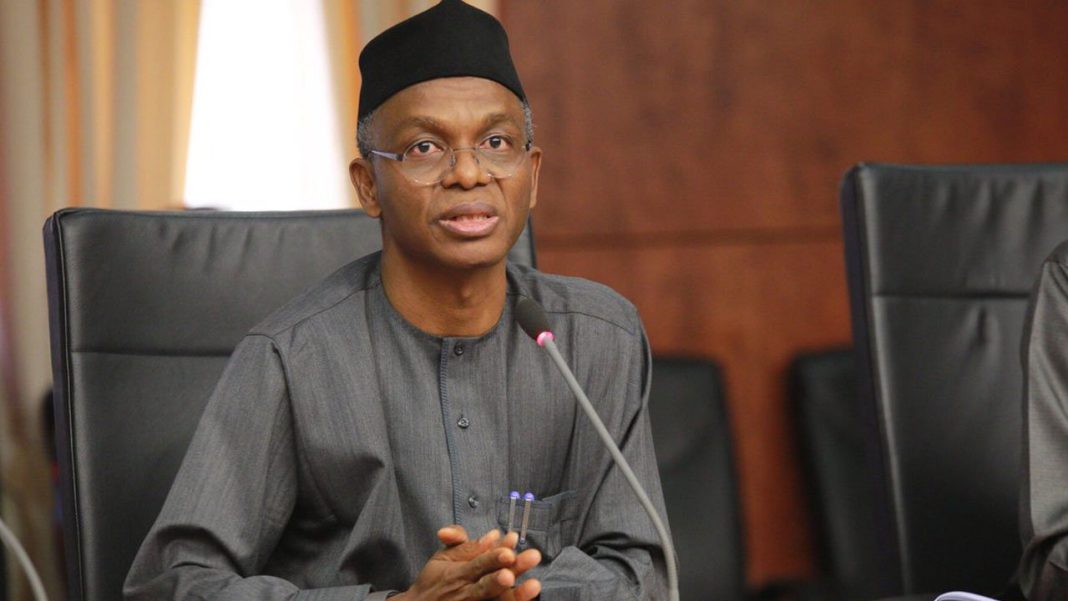
Former Kaduna State governor Nasir El-Rufai has alleged that President Bola Tinubu’s administration may be connected to a move in the United States congress to blacklist Rabiu Kwankwaso, the former Kano governor and leader of the New Nigeria Peoples Party (NNPP), over alleged religious freedom violations.
El-Rufai suggested the push may be politically motivated, claiming it could be linked to Kwankwaso’s refusal to defect to the ruling All Progressives Congress (APC) and rumours that he may instead align with the African Democratic Congress (ADC).
Speaking on Arise TV’s Prime Time programme on Friday, El-Rufai described Kwankwaso’s inclusion in a proposed US bill as unjustified and selective, raising questions about why other northern politicians associated with Sharia implementation were not mentioned.
The bill in question, the Nigeria Religious Freedom and Accountability Act of 2026, was introduced by US congressman Riley Moore, a Republican representing West Virginia, and co-sponsored by Chris Smith, a Republican representing New Jersey.
Moore announced the proposed legislation on Tuesday via X, formerly Twitter. The bill recommends targeted measures including visa bans and asset freezes against individuals and organisations accused of involvement in religious freedom violations in Nigeria.
Kwankwaso is named alongside Fulani-ethnic nomad militias and associations including the Miyetti Allah Cattle Breeders Association of Nigeria and Miyetti Allah Kautal Hore.
In a key provision, the bill calls for the US state department and treasury to impose sanctions under the Global Magnitsky Human Rights Accountability Act on those deemed responsible, listing “(A) Fulani-ethnic nomad militias in Nigeria, (B) Rabiu Musa Kwankwaso, former Kano State Governor, (C) Miyetti Allah Cattle Breeders Association of Nigeria, and (D) Miyetti Allah Kautal Hore”.
El-Rufai said the inclusion of Kwankwaso appeared to defy logic, given that Sharia law was adopted across multiple northern states.
“I think it is most unfair to tag Kwankwaso,” he said. “And I’m trying to figure out whether it is the $9m lobbying money that led to his listing because Kwankwaso has refused to move to APC.”
He went further, alleging that the Tinubu administration could be behind the move.
“The evil that this government is capable of is beyond our imagination – they may be behind it because he has refused to move to the APC, and there are rumours that he will move to the ADC,” El-Rufai said.
He argued that if Sharia implementation was to be cited as justification, the focus should instead fall on Zamfara State, where the policy was first introduced.
“Twelve northern states implemented Sharia. The first state to do so was Zamfara. I thought Zamfara should be listed there if anyone is to be blamed for this Sharia fiasco,” he said.
“Kwankwaso followed suit like many other northern governors, and Kano was not very strict in implementing Sharia.”
El-Rufai insisted that Kwankwaso was not known as a religious hardliner, and accused the bill’s sponsors of ignoring more extreme cases.
“Kwankwaso is not one of the governors you would call a fundamentalist,” he said. “Those who cut off the hands of Danladi Gengebe or others are working the streets freely. They are in APC.
“Nobody is mentioning their states or mentioning Yerima Bakura or Abdulaziz Yari, governors of Zamfara State, who protected and promoted Sharia. But it is Kwankwaso who is being targeted.”
He warned Nigerians not to accept the American move at face value, suggesting it was shaped more by US domestic politics than genuine concern for Nigeria’s security crisis.
“As Nigerians, we should not get carried away and be pawns in what is essentially domestic political posturing,” he said, describing the “Christian genocide” narrative as a Republican appeal to evangelical voters.
“This whole narrative and the latest bill is just the Republicans playing to their base – the Christian evangelical base in the US. It has nothing to do with Nigeria,” he added.
El-Rufai also used the moment to criticise Nigeria’s security failures, saying both Christians and Muslims remained vulnerable to violence.
“It is heartbreaking that as a government, as a country, we are unable to protect all our citizens, whether they are Christians or Muslims,” he said. “Everyone is at risk, and that is what we should worry about.”
He said the country’s security system had collapsed either through incompetence or failure to act decisively.
“It is clear that the country is not secure,” he said. “The security architecture has failed; the personnel are incompetent or are not doing the job, and we need to ask some very difficult questions so that it is recalibrated, and every Nigerian will feel safe.”

