



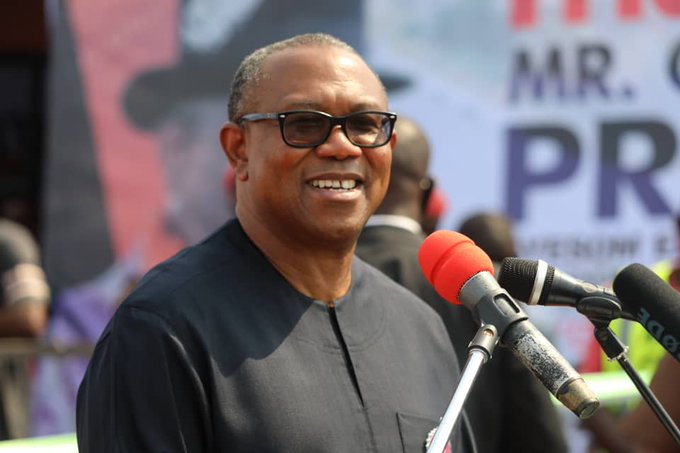
Peter Obi, the Labour party’s presidential candidate in Nigeria’s 2023 election, has urged Nigerians to unite behind what he called an “Operation Rescue Nigeria”, framing the 2027 presidential contest as a generational struggle against decades of poor governance.
Speaking on Saturday in Uyo, Akwa Ibom state, at an OBIDIENT Conference and official declaration event for the African Democratic Congress (ADC), Obi told supporters that the movement was not about personal ambition but about the future of a country he said had been repeatedly failed by its leaders.
“Operation Rescue Nigeria is not for me as an individual,” he said, “but for the collective future of generations who will bear the consequences of persistent bad governance.”
The conference, themed “Activating the PO Effect in ADC,” marked a further step in the political realignment of Obi’s supporters, popularly known as the Obidient movement, as preparations begin in earnest for the next general election.
Obi called on Nigerians to set aside divisions and focus on electoral mobilisation, placing particular emphasis on the credibility of vote transmission and result declaration.
“Nigeria must get it right in 2027,” he said. “Election results must be transmitted online in real time, and whoever fails to transmit results will be transmitted. Democracy must work. I appeal to you to join hands with me to rescue this country.”
Obi also offered a blunt explanation for his departure from the Labour party, claiming he had been informed that Nigeria’s electoral commission would not recognise the party’s leadership while he remained there, and suggesting the federal government did not want him on the ballot.
“I left the Labour party when I got informed that as long as I remain in the party, INEC will not recognise its leadership, and the federal government does not want me on the ballot,” he said.
“But I want to assure you that I will contest the coming election even if it is held in their bedroom. And if they don’t want to transmit the result, we will transmit it for them.”
In a sharp critique of the Tinubu administration, Obi accused the government of taking on unprecedented levels of debt, warning that the cost would be borne by Nigerians long after the current political class had exited the stage.
“The current administration has collected more loans than every other administration,” he said, “and most of these loans will be repaid between 2045 and 2050, when many who plunged the country into this indebtedness are no more.”
Obi said his priorities, if elected, would include heavy investment in education and healthcare, arguing that the development of prosperous nations had been driven by deliberate and sustained spending on human capital.
He pledged to tackle poverty and insecurity, promising to engage directly with institutions across the country to understand the realities facing young Nigerians.
“I will tour the entire country and visit all higher institutions to understand the real challenges on the ground,” he said. “I want to help fix Nigeria now that I have the strength to undertake difficult tasks.”
On corruption, Obi sought to reinforce his long-standing image as an austere public official, citing his time as governor of Anambra state.
“When I became governor of Anambra state, I advised my wife to forget about the office of first lady. We were not elected together,” he said.
He added that although he approved more than 100 certificates of occupancy for government lands, he did not allocate any to himself or his family.
“If you find any, petition me to the appropriate authority,” he said.
The coordinator of the Obidient movement worldwide, Dr Tanko Yunusa, urged supporters to channel their organising energy into the ADC as a platform for what he described as national transformation.
Akwa Ibom’s state coordinator of the movement, Dr Ben Smith, warned against internal divisions, insisting that the 2027 election must be framed as a fight for the country’s future.
“The 2027 presidential election is not about an individual but about a generation – jobs for youths, security for families, dignity for workers, and hope for every Nigerian,” he said.
In a statement issued on Sunday, Yunusa said mobilisation had already begun across wards and local government areas, as supporters moved to build grassroots structures ahead of 2027.
“This is Uyo, Akwa Ibom state, as we continue to mobilise into the ADC,” he said. “The strong words of His Excellency Peter Obi are very clear: we will not allow a repeat of what happened in the 2023 election.”
“In 2027, you will either count the votes correctly, or you will be counted. We must all be ready to defend our votes.”
Calling for intensified political engagement, Yunusa urged coordinators, volunteers, youth leaders, women and elders to organise ward meetings, strengthen polling unit structures and begin voter mobilisation.
The movement, he said, would “strategically align” with the ADC as it prepares for what Obi’s supporters increasingly view as a decisive election – not just for power, but for the soul of the Nigerian state.

